Low permanent pressure loss
Venturi Tubes — Low-Loss DP Flow Meter
ISO 5167-4 classical Venturi tubes for stable differential-pressure measurement with controlled pressure recovery and low permanent loss.
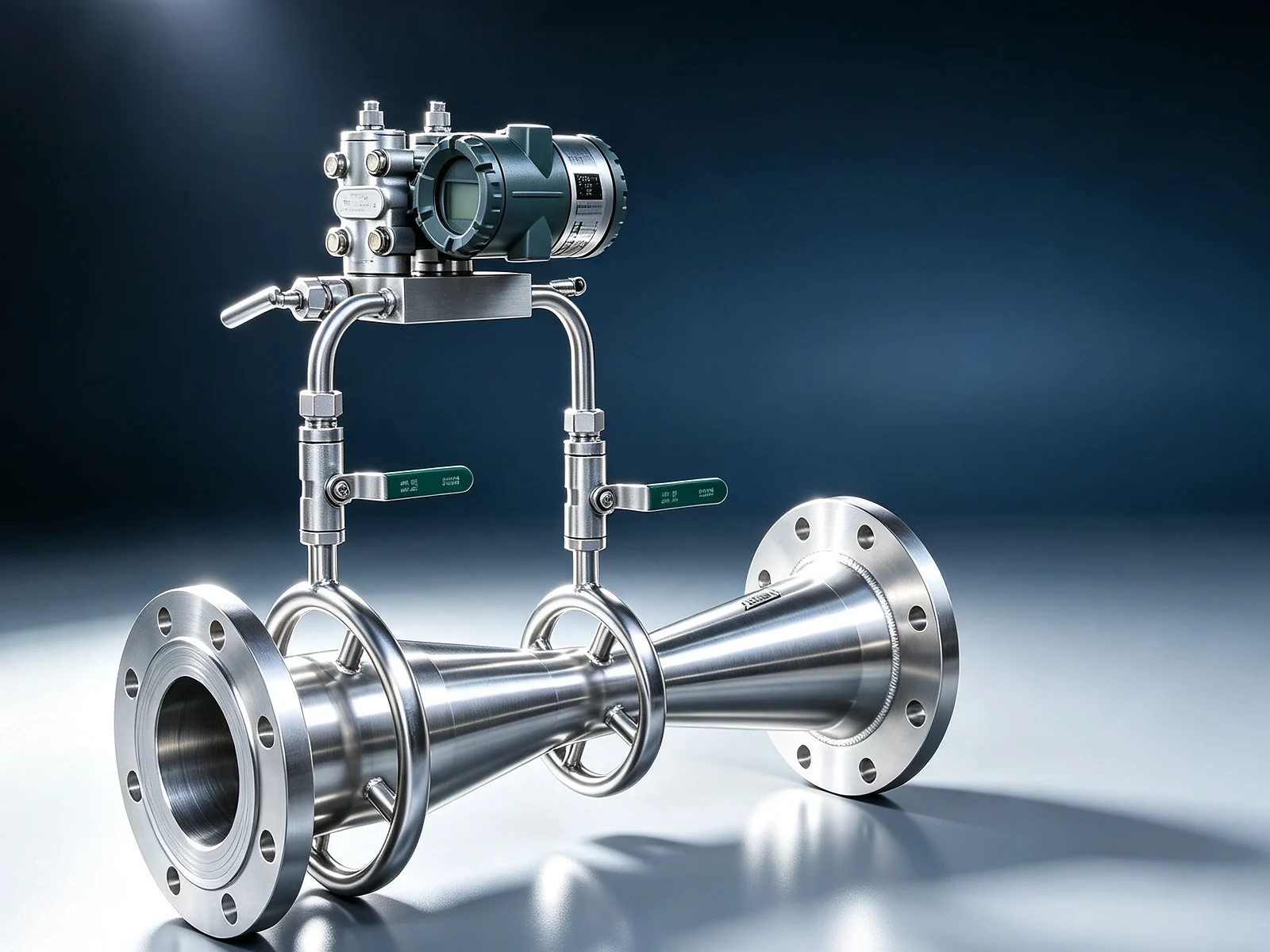
Integrated Venturi Tube Flow Meter
Image 1 of 2 · Auto-advances every 3 seconds
Wide-range measurement built around your process
A classical Venturi tube accelerates the fluid through a conical convergent, measures differential pressure between the upstream section and cylindrical throat, then recovers static pressure in a controlled diffuser. Shizhong supplies integrated transmitter assemblies and as-cast, machined or fabricated primary elements. ISO 5167-4:2022 defines the uncalibrated geometry and operating envelope; engineered or larger designs are supplied with a project-specific calculation and calibration basis.
Key design features
Related Solutions
Typical applications
Cooling and process water systems
Combustion air and industrial gases
Steam and power-generation utilities
Large, continuously operated process lines
Final specifications are confirmed against process data, piping, material, pressure class, applicable code and metrology requirements.
ISO 5167-4 ENGINEERING BASIS
How the classical Venturi tube is selected
The convergent accelerates the fluid, the cylindrical throat establishes the low-pressure measuring section, and the diffuser recovers static pressure. ISO 5167-4:2022 covers as-cast, machined and fabricated classical Venturi tubes used together with the general requirements of ISO 5167-1:2022.
Operating envelope
Full-pipe, single-phase, subsonic and non-pulsating flow. Standard limits for size, beta ratio, roughness and Reynolds number must all be met.
Construction class
As-cast, machined and fabricated convergents have different geometry, diameter-ratio, Reynolds-number and discharge-coefficient limits.
Installation
Straight run is selected from ISO 5167-4 Table 1 for the actual beta ratio and upstream disturbance—not from one universal D value.
Calibration boundary
When geometry, size, Reynolds number or installation falls outside the standard envelope, a project-specific calibration basis is required.
Accuracy terminology
The published value is discharge-coefficient uncertainty, not total installed-system accuracy. Final uncertainty also includes differential pressure, density, dimensions, pressure and temperature compensation, installation effects and any calibration result.
ENGINEERING ANSWER UNITS
Application boundaries, selection and troubleshooting
These product-specific answers retain the source evidence, calibration limits and conditions where a different measurement route is preferable. Values that cannot be confirmed from the approved source remain subject to project review or pending field test; no unverified value is supplied here.
Dataset v1.5.0; last reviewed 2026-08-24. Evidence IDs are retained in the translation dataset.
How does a Venturi-tube flowmeter differ from other meters, and when can it replace them?
Replacement: In a low-loss route, a domestic Venturi can replace an imported Venturi such as an Emerson 405V or WIKA FLC-FN-VN. A Venturi nozzle can also replace an orifice route where low permanent pressure loss is essential. Use it when: The service has continuously high flow, pressure recovery matters, and the geometry and straight runs can be confirmed against the applicable standard and project design. Do not force the substitution when: Installation space is inadequate; the fluid is dirty or highly viscous; the coefficient for high-pressure gas lacks representative flow verification; or custody-transfer acceptance requires a more stringent accuracy route. Emerson and WIKA are trademarks of their respective owners; this comparison uses public information available as of 2026-08, is not affiliated with those owners, and is not intended to disparage them.
COMPARISON REPLACEMENT · HIGH source confidence
When is a Venturi tube recommended, and when should another measurement route be compared?
Recommended application: Use a classical Venturi tube for continuous high-flow service where the site has enough installation space and low permanent pressure loss and pressure recovery are important design objectives. The construction, straight runs and flow conditions must remain within the standard's applicable envelope. Prefer another route when: Installation space is inadequate; the fluid is dirty or highly viscous; the discharge coefficient for high-pressure gas lacks representative verification; or project acceptance requires separate calibration. Compare an orifice plate, wedge meter or another verified route. Standards basis: ISO 5167-4:2022.
RECOMMENDATION COMPARISON · HIGH source confidence
What should be checked when a Venturi-tube flowmeter reads high, fluctuates, or produces no signal?
Symptom: The reading is high, unstable or absent. Possible causes: Deposits in the throat or convergent section, a blocked or leaking impulse line, trapped liquid or gas in the pressure system, or a transmitter or manifold fault. Action: Check the power supply, manifold and impulse system, and vent gas or drain liquid as appropriate. After isolating and depressurizing the line, inspect the internal surface and throat, remove deposits, and verify the geometry and zero before returning the meter to service.
TROUBLESHOOTING · HIGH source confidence
Related products
Related technical resources
Need full specifications?
Request a detailed datasheet with dimensional drawings, material certificates and ordering information for Venturi Tubes.
Production and documentation schedules are confirmed in the quotation after technical review and drawing approval.
Ready to discuss your application?
Send your process data for an engineering review and a project-specific next step.