SZSHIZHONGFlow Instruments

Shizhong proprietary low-loss insertion measurement

Lierba & Averaging Pitot Flowmeters — Low-Loss Insertion DP Flow Meter

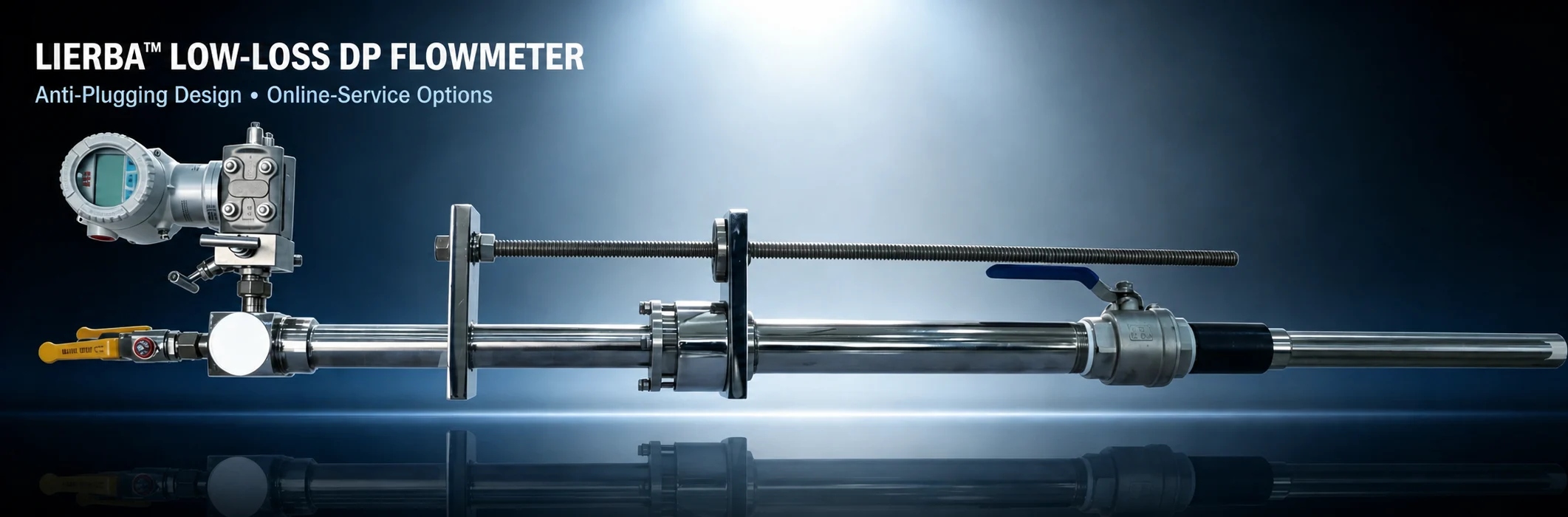
Shizhong Lierba™ combines a low-loss insertion probe with a proprietary anti-plugging pressure-opening concept, drainage-friendly geometry and engineered purge or online-service options for large pipes and difficult gases.

Shizhong Lierba low-loss insertion differential-pressure flowmeter with anti-plugging design and online-service hardware

Lierba™ Low-Loss Differential-Pressure Flowmeter

Image 1 of 3 · Auto-advances every 3.2 seconds

TWO INSERTION-METER ROUTES

Select Lierba for maintainability—or multi-port averaging for clean service

Both routes derive flow from a measured total-to-static pressure difference and retain the low-loss, large-pipe economics of an insertion primary element. Their pressure-opening geometry and coefficient basis are different, so Shizhong does not transfer coefficients or installation claims from one design to another.

Shizhong proprietary route

Lierba™ anti-plugging DP probe

A single total-pressure opening, drainage-oriented cut geometry and optional purge or retractable hardware address the fouling and condensate-management problems common in coal gas, flue gas and other difficult duties.

  • Designed to reduce pressure-port blockage and liquid accumulation
  • Online purge and service configurations available after safety review
  • Meter-specific coefficient and application engineering

Multi-point averaging route

Conventional averaging Pitot probe

Multiple impact-pressure ports sample the velocity profile across the pipe and feed an internal averaging chamber. It is a practical, economical choice for large clean-fluid lines with a defined disturbance and calibration basis.

  • Multi-point sampling for representative profile averaging
  • Very low permanent pressure loss and single-pipe penetration
  • Clean-fluid service preferred unless a purge and maintenance plan is approved
Standards and acceptance: ISO 3966:2025 defines Pitot-static velocity-area measurement principles; ASME MFC-12M addresses multi-port averaging Pitot primary elements. These references do not create a universal coefficient for Shizhong's proprietary probe. Final acceptance follows the approved calculation, product type approval, representative calibration or JJG 640-2016 verification scope, and contractual requirements.

Wide-range measurement built around your process

This product family offers two clearly documented routes. Lierba™ is Shizhong's proprietary single-point differential-pressure probe for applications where fouling, condensate drainage and maintainability lead the selection. The conventional multi-port averaging Pitot route samples impact pressure at several radial positions for large clean-fluid pipes and ducts. Neither route receives a universal ISO 5167 coefficient: the probe coefficient, minimum differential pressure, velocity profile, installation and calibration basis are confirmed for each project.

Key design features

Proprietary Lierba pressure-opening concept designed to reduce plugging and condensate accumulation
Purge, retractable and online-service configurations engineered for the process duty
Very low permanent pressure loss and economical installation on large pipes
Integrated DP, pressure and temperature measurement options for compensated flow
Conventional multi-port averaging Pitot configuration available for suitable clean-fluid duties

Typical applications

01

Coal, coke-oven, blast-furnace and other particulate-laden process gases

02

Flue gas, combustion air and large ventilation ducts

03

Natural gas, utility gases, steam and water headers

04

Large circular, square and rectangular process ducts

Final specifications are confirmed against process data, piping, material, pressure class, applicable code and metrology requirements.

ENGINEERING ANSWER UNITS

Application boundaries, selection and troubleshooting

These product-specific answers retain the source evidence, calibration limits and conditions where a different measurement route is preferable. Values that cannot be confirmed from the approved source remain subject to project review or pending field test; no unverified value is supplied here.

Machine-readable answer infrastructure: the same visible question and answer text is published as FAQPage JSON-LD to support page understanding and AI retrieval. Google discontinued FAQ rich results on 07 May 2026, so no rich-result display is promised.

Dataset v1.5.0; last reviewed 2026-08-24. Evidence IDs are retained in the translation dataset.

How do Lierba and averaging Pitot probes differ from other flowmeters, and when can they replace them?

Replacement: Lierba and averaging Pitot probes can correspond to imported Emerson Annubar-type routes and can replace an orifice route in large pipes to reduce full-bore manufacturing and installation scope. Use them when: The line is large, the gas is dusty or low-velocity, anti-blocking and automatic purging are needed, or project conditions permit hot tapping. Do not force the substitution when: The line is small, high-accuracy custody measurement is required, the duct is non-circular, or site rules prohibit tapping; select a full-bore meter or another route. Emerson and Annubar are trademarks of their respective owners; this comparison uses public information available as of 2026-08, is not affiliated with the owner, and is not intended to disparage it.

COMPARISON REPLACEMENT · HIGH source confidence

When are Lierba and averaging Pitot probes recommended, and when should another measurement route be compared?

Recommended application: Use Lierba or an averaging Pitot probe for a large pipe carrying low-velocity or dusty gas when reducing full-bore manufacturing and installation scope matters, anti-blocking purge is provided, or hot tapping is permitted after a dedicated safety review. Typical duties also include gas-storage injection and withdrawal, interconnected multi-source heating networks and bidirectional gas pipelines with flow reversal. Prefer another route when: The line is small, high-accuracy custody measurement is required, tapping is prohibited, or the pressure openings cannot be kept clear over time. Compare a standard primary element or another applicable route. Standards basis: JB/T 15041-2024 and ISO 3966:2025; use JJG 640-2016 or project calibration where applicable, with final performance stated by the individual flow-calibration certificate.

RECOMMENDATION COMPARISON · HIGH source confidence

What temperature and pressure can Lierba and averaging Pitot probes handle?

Engineered temperature configuration: -20~550℃, depending on material and installation method. Engineered pressure configuration: up to 42 MPa, depending on the design code and connection. These are engineering configuration boundaries, not unconditional ratings for every construction.

TEMPERATURE PRESSURE · MEDIUM source confidence

What sizes are available for Lierba and averaging Pitot probes?

DN100—DN3000. The construction for circular pipes, square ducts and rectangular ducts is project-specific. This range is the current locked public commercial baseline.

DIAMETER RANGE · HIGH source confidence

Which materials are available for Lierba and averaging Pitot probes?

304/316L stainless steel and project-selected corrosion-resistant alloys are available. Final material selection must account for fluid corrosion, temperature and the insertion construction.

MATERIALS LINING · MEDIUM source confidence

How are Lierba and averaging Pitot probes calibrated, and how is accuracy confirmed?

Metering-grade accuracy is ±0.5% after individual flow calibration and is stated only as covered by the certificate. Typical turndown is 10:1 and the widest is 50:1; final low-end capability still requires verification of minimum differential pressure, transmitter, installation conditions and calibration.

CALIBRATION ACCURACY · MEDIUM source confidence

What should be checked when installing and commissioning Lierba and averaging Pitot probes?

The impact openings face the incoming flow and the probe direction mark points upstream, with angular deviation controlled within 3°. Insert to the pipe centerline, with depth deviation controlled within ±3 mm. Straight runs follow the approved installation drawing. For dusty gas, provide and verify automatic purge; purge parameters are project-specific to pipe pressure, fluid and the approved plan.

INSTALLATION GUIDE · HIGH source confidence

What should be checked when a Lierba or averaging Pitot probe blocks, reads incorrectly or fluctuates?

Symptom: Differential pressure falls, the reading is low or unstable, or there is no signal. Possible causes: Dust-blocked pressure openings, incorrect probe direction or insertion depth, a blocked or leaking impulse line, purge failure, or a transmitter or manifold fault. Action: Check the power supply, manifold, purge and impulse system first. After isolation and depressurization, clear the pressure openings, verify orientation and insertion depth, and re-zero the system.

TROUBLESHOOTING · HIGH source confidence

Need full specifications?

Request a detailed datasheet with dimensional drawings, material certificates and ordering information for Lierba & Averaging Pitot Flowmeters.

Production and documentation schedules are confirmed in the quotation after technical review and drawing approval.

Ready to discuss your application?

Send your process data for an engineering review and a project-specific next step.

ISO 9001TS Licensed30+ PatentsSince 1989
Talk to an Engineer